Thursday, September 11, 2008

building the figure


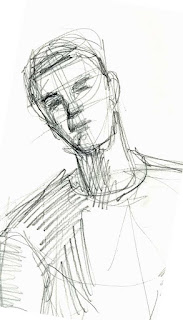
Marcelo Lima, life drawing class demonstration drawings (details),
pencil on paper, A2 paper size, 2008


Two drawings (details) showing different stages of the process of drawing from the live model, building the figure by placing lines and marks with a sense of overall volume construction, direction of light, formal rhythm, relations and proportions. Figure Drawing class Fall 2008.

Monday, May 26, 2008

Self Portrait: Method and Representation

A project of my Advanced Drawing course (AUD) in the Spring 2008. To explore different strategies and methods of drawing portraits as observed, for instance, in the works of Chuck Close: use of photography, use of grids, a systematic approach to image building as process, etc.


Madiha Muzaffar, Self Portrait, charcoal on paper, A0 paper size


Nourhan Darwish, Self portrait, ink on paper, A1 paper size


Lama Helweh, Self portrait, charcoal on paper, A1 paper size

Lama Helweh, Self portrait, pastel on paper, A0 paper size

Sunday, February 17, 2008

Drawing and Photo-Collage Project

Dr. Marcelo Lima – Figure Drawing, Fall 2007

A series of drawings based on photo-collages. The project is inspired by the photo-collages of David Hockney, but also by the still-life paintings of Cezanne. The goal is to explore “stereoscopic” effects in a two-dimensional plane by overlapping, contrasting and complementing different points of view in one composition. The photos are taken from the model in class and arranged as an actual collage of prints or using Photoshop as a “sketching” and composition tool.

Things to consider or to look for:

- A three-dimensional sense and effect of volume in space created on the picture plane by taking into account minor or major variations of point of view among the shots.

- The figure within its spatial environment.

- The compositional possibilities of a regular and an irregular grid.

- Interactions between shallow and deep space and spatial signs or cues.

- Use of frontal shots of all the areas of the complete composition: pictorial elements are seen as parallel to the picture plane.

- Surface qualities and tones:both photographically and manually produce.

- Forms, shapes, negative spaces.

- Light and color (tone) contrasts.

- Relation to the viewer.

The objective is to translate the photo-collage into a drawing, not simply to copy it.

students' works:

Muna Mohammad


Madiha Muzaffar


Friday, October 26, 2007

Marcelo Lima, Figure Study,
charcoal on paper, demonstration drawing for
Free Hand Drawing II Class, Spring 2007

Tuesday, October 16, 2007

Model with projected images

photo by Natalie Abou El Hessen


A variation of the well-known strategy of slide projection over the living model is seen here: the projection of a digital image, in this case a still from Eisenstein's Battleship Potemkin (1925, available at archive.org).

Still and moving images can be used, adding variety and difficulty to perception and to the rendering of human form. The aim is to de-familiarize the figure, to create new challenges to perception in order to preclude the use of ready-made formal concepts and strategies.

Shadow Drawing project


The invention of drawing

Joseph-Benoît Suvée
Belgian, about 1791
Black and white chalk on brown paper (recto); graphite (verso)
21 1/2 x 14 in.
source: Getty


The story is told by Pliny the Elder (Caius Plinius Secundus, AD 23 – August 24, AD 79) in his work Natural History (Naturalis Historia, circa AD 77 ): a maid of Corinth traced her departing lover’s shadow on a wall and thereby invented art.

Drawing started by extracting from the unstable figure of a shadow the record of a presence as visible memory and remembrance.

The Shadow Drawing project aims at the perception and recording of the human figure as tonal mass. In the present display, two lamps at different angles give compound shadows that require the rendering of the variations of value projected on the white sheet, away from the simple consideration of silhouette.


Student drawing (Madiha Muzaffar)
Figure Drawing Class, AUD

Monday, October 15, 2007

Figure Drawing Class Fall 2007


Marcelo Lima - "Écorché" (flayed) figure (adapted from F. Schider - Atlas of Anatomy for Artists, 1929), a quick demonstration sketch, charcoal on paper, 59 x 42 cm, 2007

Saturday, May 19, 2007

Painting II Class Spring 2007


at the Visual Communication Program, American University of Dubai. UAE
photo by Cima Azzam

Sunday, March 25, 2007

Valery on Leonardo and creativity

"A work of art should always teach us that we had not seen what we see"

"Nine times out of ten, every great improvement in a field of endeavors is obtained by the intrusion of methods and notion that were not foreseen within it. [...] All the minds that have served as substance to generations of seekers and quibblers, all those whose remains have nourished, for centuries on end, human opinion and the human mania for echoing, have been more or less universal."

Paul Valery- Introduction to the method of Leonardo da Vinci [1894]

Wednesday, March 07, 2007

An exercise in figure drawing: mass and tone

To obligate the student to see and draw masses and tones, avoiding initial delineation of outline (flat, “cut-out” style) and thinking rather in terms of dimensional space, volumes and haptic (tactile, muscular) responses and textural elements, I use a transparent black cloth veiling the model. A light behind the veil will throw into relief the articulations of planes of the figure (according to the illustrations below). Not being able to see precise contours obligates the aspiring artist to approach form and shading in a different spirit, with a new strategy and concept.


photos by Marcelo Lima (c) 2005

The methods of the painters: Euan Uglow (1932-2000)

Euan Uglow
Reclining Nude
Pencil, c.1980
9 x 14 ins
http://www.archeus.co.uk/pages/single/656.html


Euan Uglow
Potifer's Wife
Oil on canvas
76.2 x 152.5 ins
http://www.archeus.co.uk/pages/single/7496.html


Approaches to painting will vary according to, among many other equally important things, personality and preferences. To ask the art student to be aware of process before results is to indicate that the process itself must be incorporated into the result, that the result is nothing else but the result of a given process.

To anticipate a “desirable” result will most of the time lead straight to “painting hell”: the student will measure his own work using the wrong scales and criteria, as an activity beyond his reach for which “shortcuts” will have to be found in the most expeditious manner, leading to mis-recognition, a false voice for false notes, frustration, etc. The price to be paid when we forget that it is in the very process of painting that the artist will discover, as in a sort of “after the fact recognition”, the real object of his efforts, what the artist was looking for without “really” knowing…

The following is one example of a methodical approach to painting that does not preclude, for the artist in question, discovery and invention. Within the restrictions of method, freedom will appear as a sort of transcendence of the subjective and the fortuitous, an experience in which the artist is the “servant” of a process of artistic invention and discovery. It implies the pride of “humility”, the courage of self-effacement, all the contradictory “virtues” (and some “vices”, most probably) related to that process of active receptiveness, passive readiness, blind faith and skeptical disposition that constitutes the mental context of the art of painting.

The following is taken from an article on Euan Uglow in Wikipedia.

“With a meticulous method of painting directly from life, Uglow frequently took months or years to complete a painting. Planes are articulated very precisely, edges are sharply defined, and colors are differentiated with great subtlety. His type of realism has its basis in geometry, starting with the proportion of the canvas. Uglow preferred that the canvas be a square, a golden rectangle, or a rectangle of exact root value, as is the case with the Root Five Nude (1976).[1] He then carried out careful measurements at every stage of painting, a method Coldstream had imparted to him and which is identified with the painters of the Euston Road School. Standing before the subject to be painted, a brush would be held upright at arm's length. With one eye closed, the artist could, by sliding a thumb up or down the brush handle, take the measure of an object or interval, to compare against other objects or intervals, with the brush still kept at arm's length. Such empirical measurements enable an artist to paint what the eye sees without the use of conventional perspective. The surfaces of Uglow's paintings carry many small horizontal and vertical markings, where he recorded these coordinates so that they could be verified against reality.”

http://en.wikipedia.org/wiki/Euan_Uglow


see also:

EUAN UGLOW: Controlled Passion
http://www.abbothall.org.uk/exhibitions/EuanUglow2003.shtml

Wednesday, February 07, 2007

Brainstorming techniques: how to generate visual ideas

Method of Word Association

Start with a short sentence related to the theme. For instance, the general theme is restraint. You may write: “Afraid of going beyond boundaries”. Or: “Economy of means”.

Alternatively, you may use the web to find a quote with the word in it. Example: “Liberty has restraints but no frontiers”, Lloyd George. (source of the quote: http://www.quotationspage.com) to help sort the many uses and nuances of the term.

Associate freely: under each word of the sentence list words that come to you mind, the essence of the free association method is that ANY association is valid, do not judge or evaluate anything as irrelevant, bad (or good), absurd, et cetera. In fact, there is no “wrong” association, and the essence of the method is to bypass our “ordinary” way of considering things from a “logical”(correct / incorrect) or “axiological” (good / bad) point of view. Do not restrain the flow of words.

The result will be a number of columns in the page. The last step is to read the columns and cross associate freely: the new associations between words from different columns will generate images or visual metaphors related to the theme.

Marcelo Lima

Saturday, January 13, 2007


Life study, pencil on paper, 2005

Figure study from life, a quick demonstration drawing at my Figure Drawing class at the American University of Dubai, Fall 2005

Tuesday, December 05, 2006

On the compulsion to symmetry

What makes the novice artist start a composition by concentrating his marks, lines or brush strokes, on the center of the canvas or sheet of paper, ignoring the dynamics of form within the total space and the active role of format (the original rectangle of the paper or canvas) in composition?

The unreflected, unconscious search to balance visual elements by means of concentration within a central space and repetition along a central axis, resulting in the creation of static arrangements and formal monotony, maybe part of a larger tendency of living matter towards an ideal "point of repose" within the ceaseless agitation of life. This unconscious drive we may name the "compulsion to symmetry", something that the art teacher (and at times the artist) has to struggle with on a regular basis in studio classes.

But rather than a "metaphysical" question, it may well be that the "compulsion to symmetry", at least in some important aspects related to formal preferences in the visual arts, is rather culturally constructed. This is suggested by the following quote from The Book of Tea by Okakura Kakuzo, a reflection and presentation of Japanese culture to Western readers published in 1906.

"The absence of symmetry in Japanese art objects has been often commented on by Western critics. This, also, is a result of a working out through Zennism of Taoist ideals. Confucianism, with its deep-seated idea of dualism, and Northern Buddhism with its worship of a trinity, were in no way opposed to the expression of symmetry. As a matter of fact, if we study the ancient bronzes of China or the religious arts of the Tang dynasty and the Nara period, we shall recognize a constant striving after symmetry. The decoration of our classical interiors was decidedly regular in its arrangement. The Taoist and Zen conception of perfection, however, was different. The dynamic nature of their philosophy laid more stress upon the process through which perfection was sought than upon perfection itself. True beauty could be discovered only by one who mentally completed the incomplete. The virility of life and art lay in its possibilities for growth. In the tea-room it is left for each guest in imagination to complete the total effect in relation to himself. Since Zennism has become the prevailing mode of thought, the art of the extreme Orient has purposefully avoided the symmetrical as expressing not only completion, but repetition. Uniformity of design was considered fatal to the freshness of imagination. Thus, landscapes, birds, and flowers became the favorite subjects for depiction rather than the human figure, the latter being present in the person of the beholder himself. We are often too much in evidence as it is, and in spite of our vanity even self-regard is apt to become monotonous."
(my italics, M.L.)

Notions worth of reflection by the art student.


text source: http://www.246.dk/teatbot.html#04


related links:

The Book of Tea

Okakura Kakuzo

Wednesday, November 01, 2006


Marcelo Lima, Anatomical study, 40x60 cm

Saturday, October 28, 2006

The study of Anatomy


Marcelo Lima, Anatomical study, charcoal on paper, 40 x 60 cm


Why should the artist who is interested in the representation of the human figure study anatomy? Why not be content with the external appearance of the body? After all, this is what matters in art. Why does the artist need to study the internal, that is the hidden, the "non-apparent" elements of the body? Precisely to be able to understand what forms the appearance that is the subject of the artist interest and effort. That is, knowing the structure and articulation of the human figure will lead the artist to know what to look for when drawing from the model, what to select and register in order to convey the workings of the human body, its formal and expressive possibilities related to the its structural components and functional elements.

How thorough must be the figurative artist´s knowledge of anatomy? Specific goals, interests and experience will tell. What constitutes basic or sufficient knowledge will certainly vary according to specific needs, aims and experience. As with any discipline, you can only tell how much you need to know for specific goals by knowing "more than you need", that is by exploring the field guided at first simply by your own curiosity and capacity to learn. The capacity to use knowledge is secondary to knowledge itself, something that the "pragmatists" of education nowadays, displaying their own ignorance and bad faith, try hard to make people forget.

The following link will direct the reader to a video course for biology students on Functional Anatomy at the University of California at Berkeley:

Integrative Biology 131: General Human Anatomy. Fall 2005. Professor Marian Diamond. The functional anatomy of the human body as revealed by gross and microscopic examination.

Monday, October 23, 2006

Value Scales


Gray and Ultramarine Blue, nine steps, oil on paper

Friday, October 13, 2006

Sketchbook / Visual Journal links

On sketchbook / visual journal / journal writing as creative tools see:

Jennifer New, author of Drawing from Life and
Dan Eldon

http://www.jennifernew.com/

Dan Eldon
http://www.daneldon.org/

The 1000 Journals Project
http://www.1000journals.com/

John Copeland
http://www.johncopeland.com/

Tuesday, October 10, 2006

Thematic Sketchbooks

The sketchbook is the artist´s laboratory, a place for exploration and discovery. The practice of keeping a sketchbook may be greatly facilitated when the task of sketching regularly is organized around a theme: a portrait sketchbook, a travel sketchbook that need not necessarily be about going on vacation in grand style to see different lands and cultures, but can also be about itineraries in daily life, everyday routes and routines, imaginary travels, symbolic paths and narratives.

Specific subjects of the natural world: trees, animals (wild and domestic), birds, marine life, plants, a given landscape seen (or imagined) during a period of time. Or subjects of the man made world: collections of objects, from the banal such as shoes, hats, tools, utensils, etc., to the complex: digital circuits, mechanical or electronic systems, etc. From the small to the vary large. For example, considering the urban environment itself (or its subparts) as a kind of "super-object".

A sketchbook about modes of visuality would explore the different ways of experiencing and recording the act or the mechanisms of seeing, points of view and perspectives. The world as seen by machines that register and extend the field of visual phenomena: cameras, microscopes, telescopes, x-ray apparatuses, infrared devices, radars. And machines or graphic systems that convey information about paths and patterns of diverse forms of energy in a graphic language, such as seismographs, etc. Or the world seen by natural creatures or maybe by other beings and celestial creatures. Merging disciplinary interests in the sciences, in the social sciences, history or the humanities, with art would be a way of generating themes for sketchbooks.

On the formal level, a graphic template or grid, flexible enough to allow for improvisation, change and contrasts, would also be an instrument providing an underlying sense of visual relationships and continuity, adding and supporting the temporal continuity of the sketchbook practice.

As with the practice of writing a journal, developing a regular sketchbook practice can also be a very efficient way of discovering subjective patterns of feeling and vision in time. Something crucial in the process of developing a unique artistic vision and a personal creative path.

On gesture drawing

Gesture drawing implies that the object of observation is not stationary and that the lines, as products of the movement of the hand, are able to convey the sense, rhythms, speed, feeling and gestalt (configuration) of the actions of the moving object. The aim in gesture drawing is to depict what the object is doing.

If we think of objects, any object, as resisting the forces of gravity, there are no immobile objects in the world. Even a stone is somehow occupied in keeping its shape, resisting, standing against the forces of the elements and against the pull of gravity of the earth, as well as the gravity of every other object and their fields of force. What we see in the world is the product of a conflict of forces, balance is a sum of efforts. Balance in life as in art is activity, not passivity.

In gesture drawing the physical act of marking the surface of the paper is the clue to the product. The drawing will reflect or express at the same time the qualities of movements of the subject and of the object. Both the physical involvement of the artist with the medium by means of the artist's own bodily actions (including hand, arm and by extension the whole body, physical posture, muscular tone, energy, speed, ect.), the artist's gestures, and the configurations of the object in space, the object's actions and what those actions communicate, that is, the understanding of the object's form and dynamics also as gesture, that is, as expressive form.